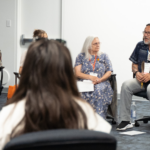
Videos from the Fall & Winter 2011-2012 Colloquium Series from the Centre for Interdisciplinary Research and Collaboration in Autism (CIRCA) are now available.
CIRCA was established in 2009 in UBC’s Faculty of Education. The CIRCA draws faculty, students, provincial service providers, policy makers, and both basic and applied researchers from BC post-secondary institutions together, to address issues of common concern that are relevant to improving the lives of individuals with autism spectrum disorders (ASD) and their families.
Posted:May 8, 2012, 9:39 a.m.
Using an ecological lens, the Environmental Scan of School Readiness for Health: Definitions, Determinants, Indicators and Interventions report explored school readiness from a health perspective. The many definitions of school readiness, determinants influencing school readiness, indicators used to measure readiness and interventions and promising practices to promote school readiness were identified and categorized.
This report was originally developed for the National Collaborating Centre for Determinants of Health, and initially released in September 2009. This version was updated by the author, Jayne Pivik, PhD.
Posted:May 2, 2012, 11 a.m.
The theme for the spring issue of the Children's Mental Health Research Quarterly is: Treating Anxiety Disorders.
Articles include:
The Quarterly is an electronic publication prepared by the Children's Health Policy Centre at SFU for Child and Youth Mental Health Services with British Columbia’s Ministry of Children and Family Development.
Posted:April 19, 2012, 8:29 a.m.
Population Data BC (PopData)'s updates include:
Posted:April 18, 2012, 9:22 a.m.
HELP’s March 2012 ECD citation list is now available. This is a listing of Early Child Development academic research publications for March 2012 and pre-prints for April and beyond. This list is located on the right hand side menu under the heading “ECD References”.
Posted:April 10, 2012, 3:09 p.m.
The new on‐line Professional Specialization Certificate in Population Health Data Analysis program provides a unique opportunity for health professionals to learn a diverse set of skills from multiple disciplines. The flexible entry program allows you to start in any term and to take up to two courses without applying to the full program.
Interested students can now apply to enroll in the Population Health and GIS course offered from May to August 2012. Registration deadline is April 20, 2012.
Other courses in the Certificate program include:
This Certificate program has been developed by Population Data BC in partnership with the Division of Continuing Studies and the Department of Geography, University of Victoria. Students who apply for and successfully complete four courses will receive a Professional Specialization Certificate conferred by the University of Victoria.
For more information or to register contact:
Maxine Reitsma, Program Coordinator, UVic Division of Continuing Studies, Phone: 250 721 6477.
Posted:March 27, 2012, 9:58 a.m.
The Including all Children and Families-Expanding Partnershipsproject has a new website. The site provides information, materials, and resources for caregivers, healthcare professionals, students, and educators of children who have been identified as vulnerable due to developmental delays, identified disabilities, or other challenges. Resources include pre-screening questionnaires that will help parents and professionals get a general idea about how well a child is doing, in all developmental areas. As well, the site offers a free online course about the development of children who are between the ages of birth and 12 years.
The Including all Children and Families-Expanding Partnerships project project has been made possible through the assistance of Social Development Partnerships Program through the Government of Canada, and builds on an earlier project entitled the Social Inclusion Project for At-Risk Infants and Children (SIP).
Posted:March 21, 2012, 11:30 a.m.
Inside the ECMap Steps March 2012 newsletter:
Steps, the ECMap Newsletter, appears five times a year and provides project updates and news and information related to the Early Child Development Mapping Project Alberta.
Posted:March 15, 2012, 11:41 a.m.
Lessons in Educational Equality
Successful Approaches to Intractable Problems Around the World
Edited by Jody Heymann and Adèle Cassola
Oxford University Press
Bringing together evidence-based recommendations and in-depth case studies of successful programs from around the world, this edited volume details effective educational equity initiatives and assesses how these models could be improved, expanded, and adapted to diverse contexts. Lessons in Educational Equality is uniquely comprehensive in its scope and its focus on how best to increase educational equality from early childhood to the tertiary level, and in contexts that span the geographic and political spectrum.
This volume offers concrete solutions to barriers based on gender, income, disability, race, ethnicity, and language. Chapters on gender address equity for female students in tertiary science and engineering programs, primary and secondary education for socially excluded girls, and equitable early childhood education for boys and girls. Socioeconomic equity is examined in chapters on promoting equal opportunities in secondary school across social class, quality primary education for the poor, and early childhood strategies for closing the achievement gap. Chapters on disability detail strategies for making inclusive education a part of the Millennium Development goals and for increasing access and achievement in tertiary education ...
Posted:Feb. 6, 2012, 2:29 p.m.
The theme for The Children's Mental Health Research Quarterly, Autumn 2011 issue, is: Preventing Problematic Anxiety.
Posted:Jan. 24, 2012, 11:46 a.m.
ACHIEVE is aimed to equip new researchers with the competencies necessary for closing the gap between measuring inner city health inequities and reducing them. The program has two main foci:
Information & Eligibility:
Important Dates: Deadline to apply: February 13, 2012; Decision announcements: May, 2012.
More Information and Application Details
Posted:Jan. 19, 2012, 12:22 p.m.
There are still spaces available in this 2-year certificate program, beginning January 2012. The program meets at UMass Boston every other month for an intensive 3-day weekend. There are 12 sessions in total. The program has already admitted a dynamic group of advanced-level clinicians representing over ten different disciplines including pediatrics, neonatology, psychiatry, psychology, social work, nursing, early intervention, early education and care, speech/language pathology and occupational therapy.
These 25 Fellows will be travelling to Boston each program weekend from around the globe (including 13 states, Chile, Peru, Singapore and Canada), to learn directly from world experts in Infant Mental Health.
For more information, please visit the Infant-Parent Mental Health Post-Graduate Certificate program website.
Posted:Dec. 13, 2011, 10:34 a.m.
It is important that Canadians have access to the most current information on how much and what type of activities are required for healthy, active living. The Early Years (0-4) were identified as a gap area in clear guidance to parents and caregivers on physical activity and reducing sedentary time.
The Canadian Society for Exercise Physiology (CSEP) and the Children's Hospital of Eastern Ontario Healthy Active Living and Obesity Research Group (HALO) held two interactive, consensus-based meetings December 5-8 to draft each of these guidelines -- the first for this age group in Canada.
They are soliciting your organization’s opinion on the draft new Canadian Physical Activity Guidelines for the Early Years (aged 0-4 years) and the Canadian Sedentary Behaviour Guidelines for the Early Years (aged 0-4 years). The stakeholder survey will be open for a period of 10 days.
For information about the Canadian Physical Activity Guidelines and Canadian Sedentary Behaviour Guidelines, please consult the CSEP website.
Take the survey now
Posted:Dec. 13, 2011, 10:33 a.m.
The Brain Research Centre November e-newsletter is now available.
In this issue:
Posted:Nov. 29, 2011, 10:08 a.m.
The new on-line Professional Specialization Certificate in Population Health Data Analysis program provides a unique opportunity for health professionals to learn a diverse set of skills from multiple disciplines. The flexible entry program allows you to start in any term and to take up to two courses without applying to the full program.
Interested students can now apply to enrol in the Epidemiological Statistics course offered from January to April 2012. Registration deadline is December 2, 2012. Course details can be found at:UVic Continuing Studies.
For more information or to register contact:
Maxine Reitsma, Program Coordinator, UVic Division of Continuing Studies
Email: maxiner@uvic.ca Phone: 250 721 6477
This Certificate program has been developed by Population Data BC in partnership with the Division of Continuing Studies, University of Victoria. Students who apply for and successfully complete 4 courses will receive a Professional Specialization Certificate conferred by the ...
Posted:Nov. 29, 2011, 10:04 a.m.
Please join the EYCDI in welcoming Christine Lenihan from 6S Marketing (http://www.6smarketing.com/ ) – a Vancouver-based digital marketing firm – in this session that will answer the questions WHAT and HOW. What are Facebook and Twitter – and more importantly, how does one use them? The session will also provide you with examples from BC-based Early Years Community Development initiatives of their experiences in using Facebook and Twitter to further their work. For example, how did the Provincial SB6 Office build their Facebook following from 277 to over 5000 in a matter of weeks? What impact did it have on their work?
Date: December 7, 2011
Time: 12:30-1:30pm (PST)
Registration: https://www3.gotomeeting.com/register/987606286 by December 2, 2011 @ 4:30pm (PST)
Posted:Nov. 23, 2011, 9:28 a.m.
The Middle Years Development Instrument (MDI) maps for both Vancouver and Coquitlam School Districts are now available to view online. In addition, the Coquitlam Community Summary has been posted.
MDI is a self-report questionnaire completed by children in Grade 4. It gathers information about the “whole child” rather than simply focusing on academic progress. As well, it allows us to hear children’s voices and so taps into areas that have great significance in children’s lives that are not typically evaluated in other assessments.
Posted:Nov. 22, 2011, 9:42 a.m.
Indicators: The official newsletter of the International Society for Child Indicators (ISCI) is now available at: http://www.childindicators.org/.
Posted:Oct. 11, 2011, 1:31 p.m.
A place-based community partnership approach working towards all children arriving at school ready to engage with the learning opportunities offered.
The newsletter can be accessed here: http://www.wch.org.au/emplibrary/lsey/14th_Edition_-_LSEY_Newsletter_June-August_2011.pdf
Contents
What’s new?
Effective Community Partnerships
Meaningful Transition Statements
The Camera Project
Community Connections
Good practice in LSEY
Professional development opportunities
Posted:Sept. 20, 2011, 10:24 a.m.
Started in 2007, the ubc-health-and-society e-mail listserv is open to any UBC affiliated faculty, staff, and students interested in issues concerning the interplay between social factors and the health of individuals and populations.
The ubc-health-and-society list aims to:
1. serve as a central forum to link the many faculty, staff, and students throughout campus interested in Health & Society issues
2. facilitate a stronger network of public and population health researchers at UBC.
Thus, this list was created to exchange Health & Society-related information, including relevant:
-lectures and talks throughout campus and the local Vancouver area
-conference announcements
-calls for papers
-grant and collaborative opportunities
-student and postdoc training opportunities
-Health and Society courses being offered on campus
-requests for assistance concerning specific areas of research
-discussion regarding new articles and literature
The list is a closed posting list-*only members* may post to the list.
TO SUBSCRIBE
A regular list that forwards each individual message, and a daily digest (gathers all messages in a 24 hour period into a single outbound message) are available.
To join the regular list, send a message to: majordomo@interchange.ubc.ca
With the following commands in the *body* of the message:
subscribe ubc-health-and-society
end
To ...
Posted:Sept. 14, 2011, 2:33 p.m.
Inside the September 2011 newsletter:
Steps, the ECMap Newsletter, appears five times a year. To access the newsletter, please click here.
Posted:Sept. 14, 2011, 2:32 p.m.
When: Various Dates
Where: Neville Scarfe Bldg, UBC
CIRCA presents their Fall Colloquium Series 2011-2012:
For more information, please visit: http://circa.educ.ubc.ca/.
Posted:Aug. 31, 2011, 4 p.m.
My Reading Tree is a community literacy hub for Greater Nanaimo and Ladysmith. To learn more about its various programs, events, podcasts and more, please visit www.myreadingtree.com.
Posted:Aug. 30, 2011, 8:58 a.m.
The Society for Children and Youth of BC (SCY) launches the first edition of the Aboriginal Child Friendly Communities Toolkit: Inclusion of the Early Years. This is a child-friendly assessment and planning resource for organizations and community members to support the early childhood development of Aboriginal children and their surrounding communities. The focus of the toolkit is on 0 to 6 year olds, however, the toolkit can be helpful for all ages, families, and communities across cultures.
Download the toolkit for free at: http://www.emailmeform.com/builder/form/j5771xTfC37vdaAEf.
For more information about SCY, visit: www.scyofbc.org.
Posted:Aug. 30, 2011, 8:57 a.m.
This certificate program provides a unique opportunity for health professionals to learn a diverse set of skills from multiple disciplines including:
The program, developed by Population Data BC in partnership with the Dept of Geography and Division of Continuing Studies at the University of Victoria, combines online and some face-to-face learning to meet the time constraints and flexibility needs of busy working health professionals. The first course, Working with Administrative Data, will be offered in September 2011.
Please visit: www.popdata.bc.ca/etu/PHDA for more details.
Posted:Aug. 30, 2011, 8:55 a.m.